Open mobile menu

Home

Work

ECHOLAB

Stepping Out of My Comfort Zone: Designing and Vibe-Coding EchoLab’s Landing Page
An illustrative sketch of a flower

Overview

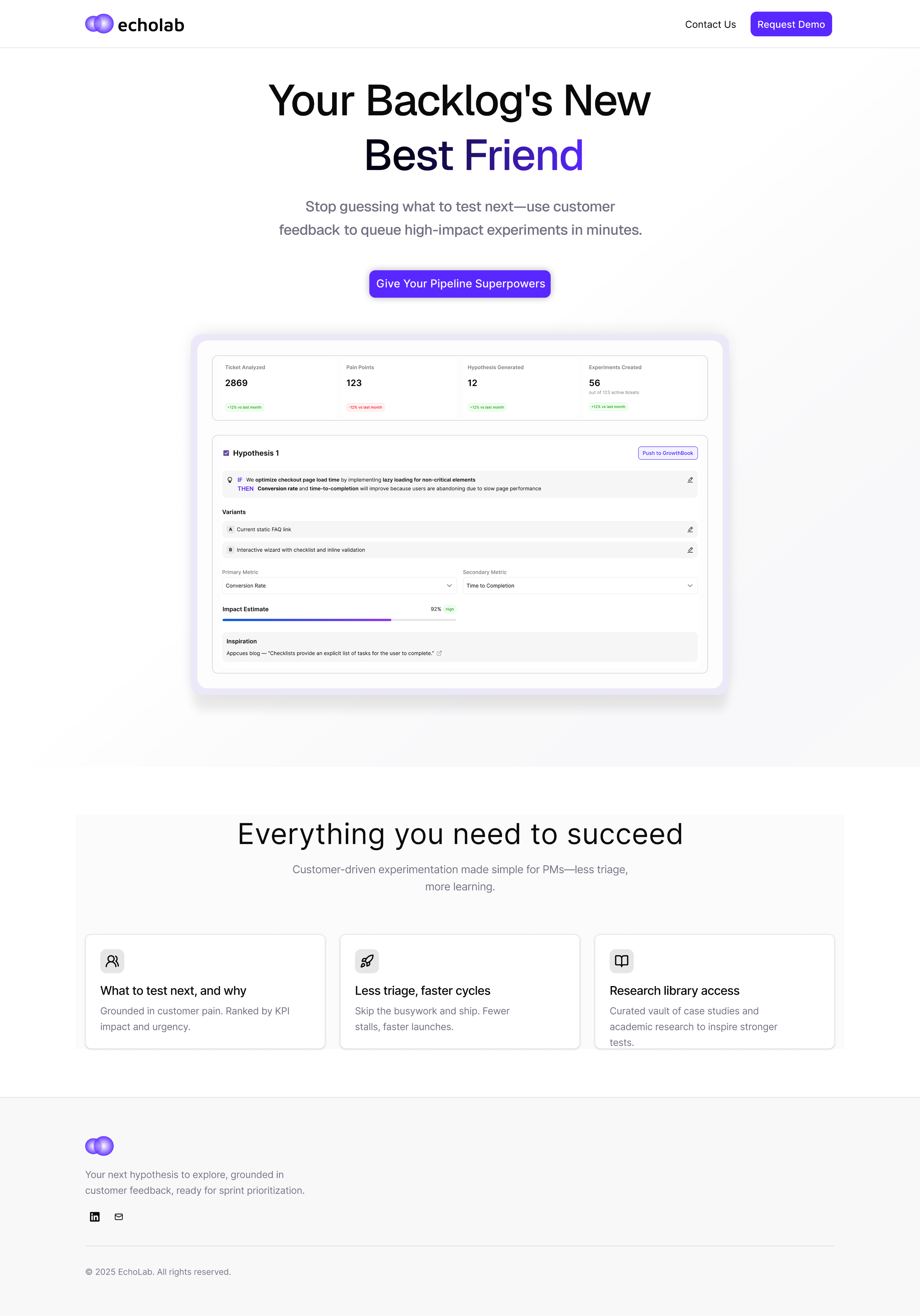
EchoLab is a ticket ingestion and A/B testing hypothesis generation platform designed to help PMs spend less time triaging and more time learning. As the MVP launch approached and engineering capacity was fully tapped, we still needed a landing page to communicate the product’s value.


I stepped in to design and vibe-code the initial landing page experience. Without established guidelines, I focused on catchy messaging, visual hierarchy, and a tone that feels exploratory yet confident. This project pushed me to trust my instincts and define the product’s identity in real time, resulting in a launch-ready page that introduces EchoLab with clarity and personality.

Role

Product Designer

Responsibilities

End-to-End UX & UI Design Process and Deployment

Collaborators

Solo Effort

Timeline

Aug 15 - 18, 2025

PROBLEM TO SOLVE

We need a landing page that introduces EchoLab’s value ahead of launch, but we have no visual identity, no brand guidelines, and no engineering support to build it.

Game Plan

Before starting the design process, I met with Product and Engineering and asked about limitations and tried understanding what was feasible. From our conversation I learned that the biggest limitations were time and resources. The deadline being November 17th and with one front-end engineer on the team, I crafted a plan.

  • RESEARCH

    In order the keep the process lean, I prioritized easy fixes that would take me the least amount of time to design and hand off.

  • TIMED EXPLORATION

    In order the keep the process lean, I prioritized easy fixes that would take me the least amount of time to design and hand off.

  • RAPID FEEDBACK LOOP

    I shared early explorations with the team in quick, informal check-ins. Even lightweight feedback helped me validate what was working and move past what wasn’t, keeping momentum without getting stuck on perfection.

IDEATION

Developing Concepts

TAKEAWAYS

What I Learned

  • Trusting intuition is a skill. Designing without rigid guidelines pushed me to make decisions based on feeling, coherence, and intention—not just structure.
  • Constraints create focus. Time guardrails and small decision frameworks kept the exploration purposeful instead of chaotic.
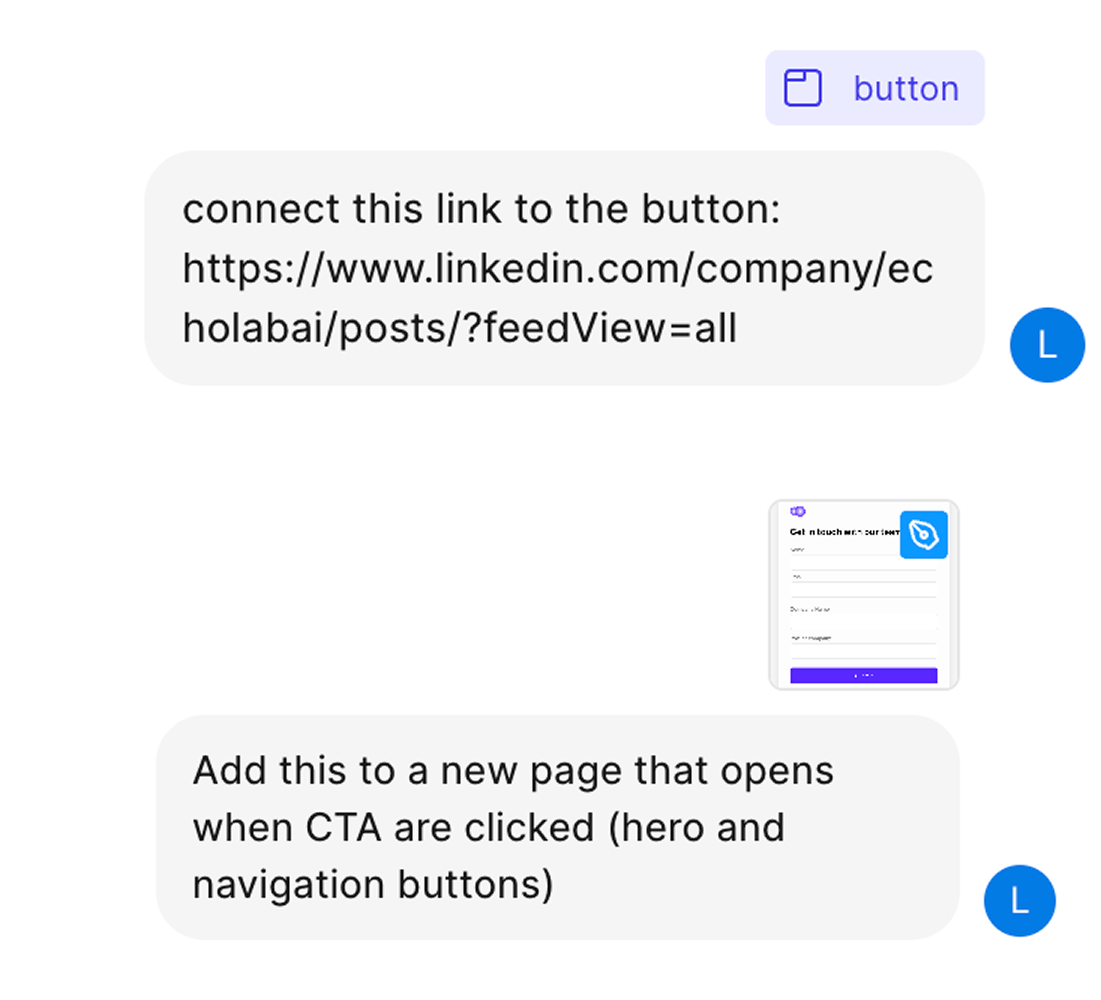
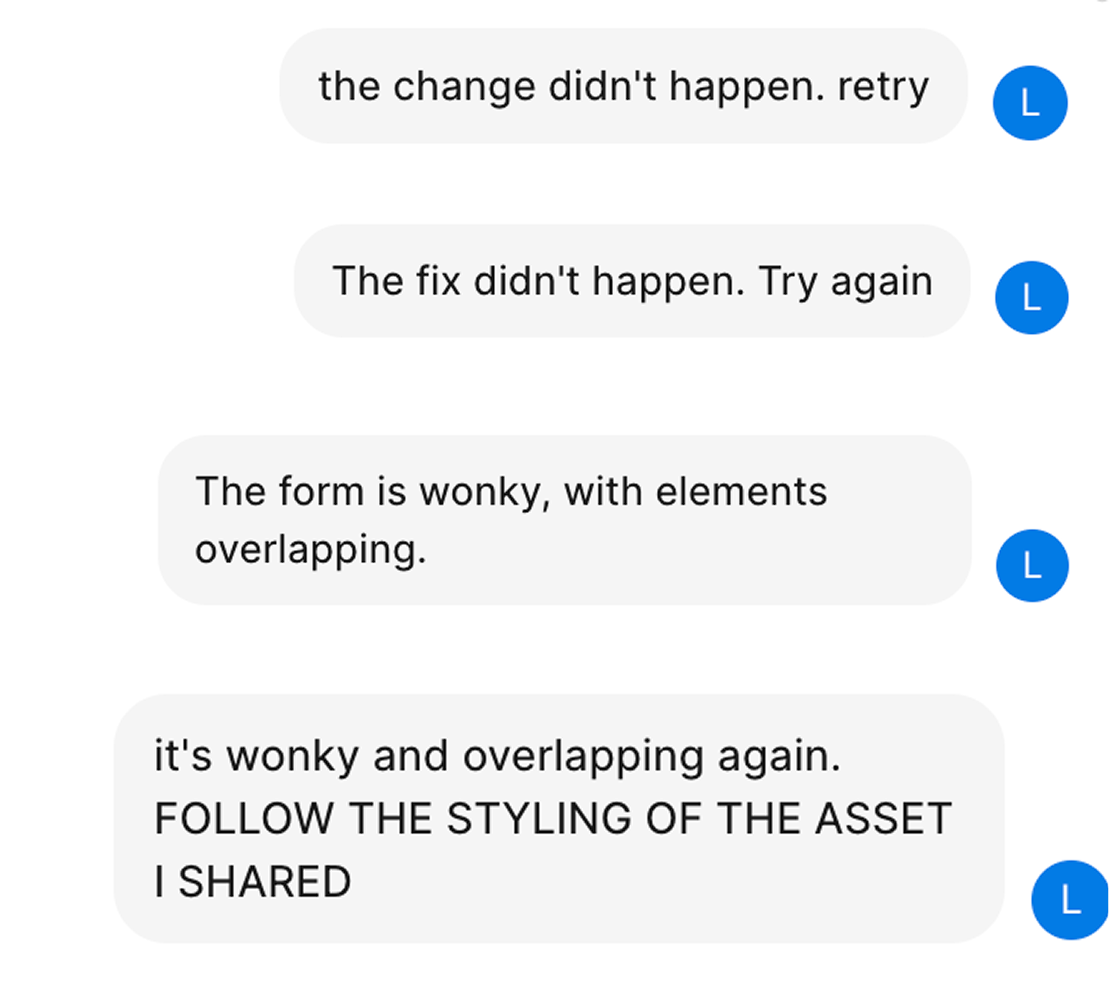
  • Tools can shape creativity. Learning how to prompt Figma Make taught me that the language I use influences the visual outcome. Clear direction produces clearer results.
  • Play leads to clarity. Treating the process like a creative playground helped me uncover the product’s visual identity naturally, instead of forcing it.
  • Identity can emerge, not just be planned. The product’s personality came from exploration, iteration, and response, not from a moodboard or pre-set style guide.

Working on something impactful? I’d love to collaborate.

Get in touch.

lenamitric@gmail.com

Back to top

© Crafted by Lena Mitric

ECHOLAB

Stepping Out of My Comfort Zone: Designing and Vibe-Coding EchoLab’s Landing Page

An illustrative sketch of a flower

Overview

EchoLab is a ticket ingestion and A/B testing hypothesis generation platform designed to help PMs spend less time triaging and more time learning. As the MVP launch approached and engineering capacity was fully tapped, we still needed a landing page to communicate the product’s value.


I stepped in to design and vibe-code the initial landing page experience. Without established guidelines, I focused on catchy messaging, visual hierarchy, and a tone that feels exploratory yet confident. This project pushed me to trust my instincts and define the product’s identity in real time, resulting in a launch-ready page that introduces EchoLab with clarity and personality.

Role

Product Designer

Responsibilities

End-to-End UX & UI Design Process and Deployment

Collaborators

Solo Effort

Timeline

Aug 15 - 18, 2025
PROBLEM TO SOLVE

We need a landing page that introduces EchoLab’s value ahead of launch, but we have no visual identity, no brand guidelines, and no engineering support to build it.

Game Plan

A quick heuristic evaluation of the existing experience revealed unclear visual hierarchy, spacing is inconsistent, and the layout feels unbalanced, resulting in an interface that isn’t intuitive to navigate.

  • RESEARCH

    In order the keep the process lean, I prioritized easy fixes that would take me the least amount of time to design and hand off.

  • TIMED EXPLORATION

    In order the keep the process lean, I prioritized easy fixes that would take me the least amount of time to design and hand off.

  • RAPID FEEDBACK LOOP

    I shared early explorations with the team in quick, informal check-ins. Even lightweight feedback helped me validate what was working and move past what wasn’t, keeping momentum without getting stuck on perfection.

IDEATION

Developing Concepts

TAKEAWAYS

What I Learned

  • Trusting intuition is a skill. Designing without rigid guidelines pushed me to make decisions based on feeling, coherence, and intention—not just structure.
  • Constraints create focus. Time guardrails and small decision frameworks kept the exploration purposeful instead of chaotic.
  • Tools can shape creativity. Learning how to prompt Figma Make taught me that the language I use influences the visual outcome. Clear direction produces clearer results.
  • Play leads to clarity. Treating the process like a creative playground helped me uncover the product’s visual identity naturally, instead of forcing it.
  • Identity can emerge, not just be planned. The product’s personality came from exploration, iteration, and response, not from a moodboard or pre-set style guide.

Working on something impactful? I’d love to collaborate.

Get in touch.

lenamitric@gmail.com

Back to top

© Crafted by Lena Mitric

ECHOLAB

Stepping Out of My Comfort Zone: Designing and Vibe-Coding EchoLab’s Landing Page

An illustrative sketch of a flower

Overview

EchoLab is a ticket ingestion and A/B testing hypothesis generation platform designed to help PMs spend less time triaging and more time learning. As the MVP launch approached and engineering capacity was fully tapped, we still needed a landing page to communicate the product’s value.


I stepped in to design and vibe-code the initial landing page experience. Without established guidelines, I focused on catchy messaging, visual hierarchy, and a tone that feels exploratory yet confident. This project pushed me to trust my instincts and define the product’s identity in real time, resulting in a launch-ready page that introduces EchoLab with clarity and personality.

Role

Product Designer

Responsibilities

End-to-End UX & UI Design Process and Deployment

Collaborators

Solo Effort

Timeline

Aug 15 - 18, 2025
PROBLEM TO SOLVE

We need a landing page that introduces EchoLab’s value ahead of launch, but we have no visual identity, no brand guidelines, and no engineering support to build it.

Game Plan

Even in uncertainty I tried being methodical, setting small guardrails for myself so I could explore freely without losing direction, especially with a tight timeline.

  • RESEARCH

    I kicked off with research, reviewing early-stage product landing pages, pulling inspiration, and quickly identifying the patterns and visual directions that felt right.

  • TIMED EXPLORATION

    I set time guardrails to stay on track within the tight timeline. I limited each exploration to 30 minutes, giving the process structure and ensuring I was intentional with where I focused my effort.

  • RAPID FEEDBACK LOOP

    I shared early explorations with the team in quick, informal check-ins. Even lightweight feedback helped me validate what was working and move past what wasn’t, keeping momentum without getting stuck on perfection.

IDEATION

Developing Concepts

TAKEAWAYS

What I Learned

  • Trusting intuition is a skill. Designing without rigid guidelines pushed me to make decisions based on feeling, coherence, and intention—not just structure.
  • Constraints create focus. Time guardrails and small decision frameworks kept the exploration purposeful instead of chaotic.
  • Tools can shape creativity. Learning how to prompt Figma Make taught me that the language I use influences the visual outcome. Clear direction produces clearer results.
  • Play leads to clarity. Treating the process like a creative playground helped me uncover the product’s visual identity naturally, instead of forcing it.
  • Identity can emerge, not just be planned. The product’s personality came from exploration, iteration, and response, not from a moodboard or pre-set style guide.